There’s a moment most business owners experience at some point on social media. You’ve been posting consistently. Your follower count is climbing. Your posts are getting likes. Someone even left a fire emoji on your last graphic. And yet — the phone isn’t ringing. The enquiries aren’t coming in. The sales aren’t happening.
If this sounds familiar, you’ve discovered one of the most important distinctions in digital marketing: the difference between an audience and a customer base.
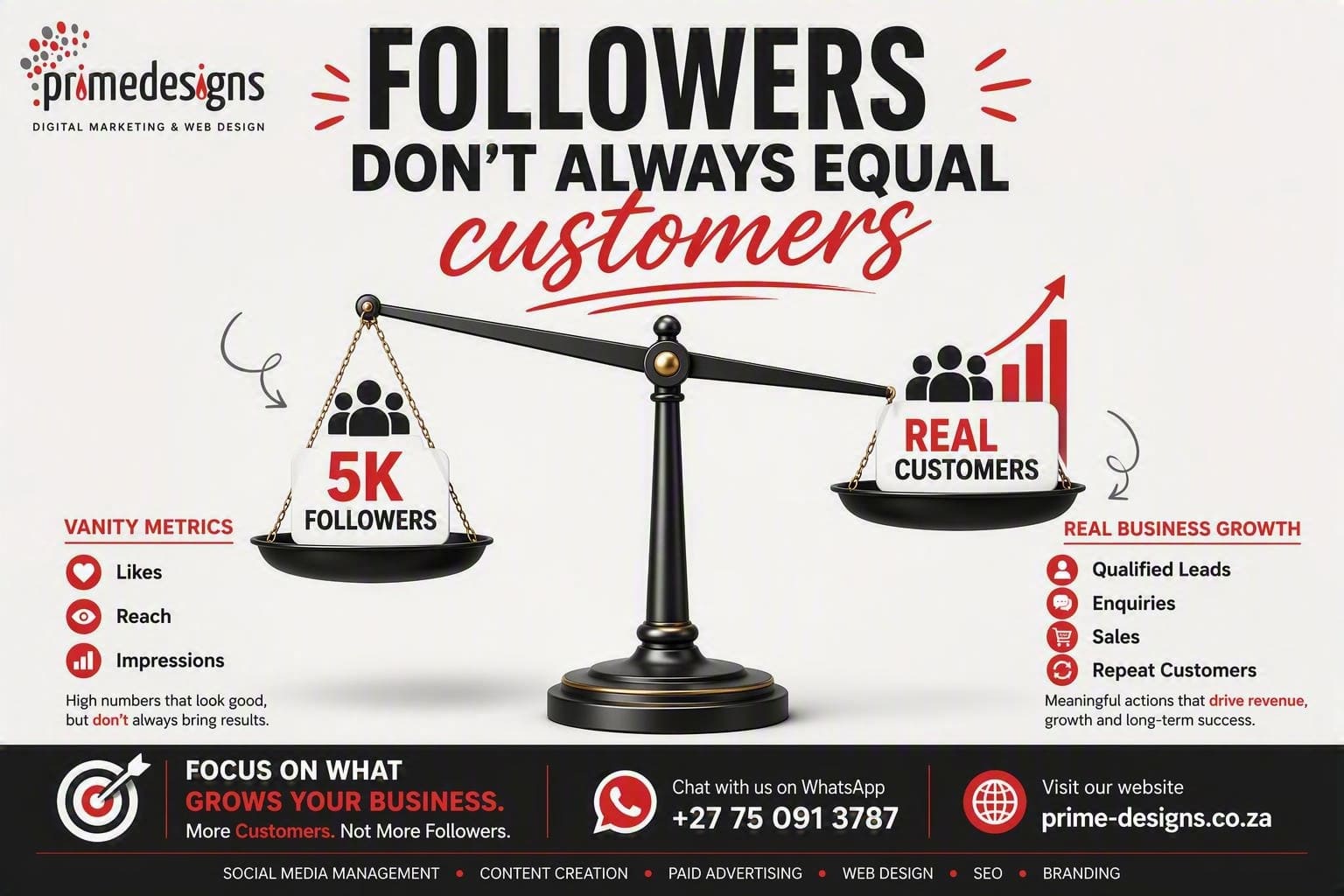
Followers are not customers. Likes are not leads. And reach is not revenue.
This isn’t to say social media doesn’t work — it absolutely does, when used correctly. But a fundamental misunderstanding of what social media metrics actually mean is costing South African businesses real money every month. This post breaks down why vanity metrics feel so good but deliver so little, and what to focus on instead.
What vanity metrics are — and why they’re so seductive
Vanity metrics are numbers that look impressive but don’t connect directly to business outcomes. On social media, the most common ones are:
- Follower count
- Likes and reactions
- Post reach (how many people saw it)
- Impressions (how many times it was displayed)
- Profile visits
These numbers are visible, they’re easy to track, and they go up when things feel like they’re working. They also trigger a real psychological reward — there’s genuine satisfaction in watching your follower count climb or seeing a post rack up 200 likes.
The problem is that none of these numbers tell you whether your social media activity is generating enquiries, bookings, or sales. A post can reach 10,000 people and produce zero leads. A page can have 15,000 followers and make no revenue from social media at all.
Meanwhile, a page with 800 highly targeted, engaged followers — people who actually need the service and trust the business — can consistently generate multiple new clients per month.
The number that matters is not how many people follow you. It’s how many of them buy from you.
Why follower count is the most misleading metric of all
Follower count has become a proxy for credibility online, and that’s understandable — a page with 10,000 followers looks more established than one with 400. But follower count tells you almost nothing about the commercial health of a social media presence.
Here’s why:
Followers accumulate for all kinds of reasons that have nothing to do with buying intent. Someone might follow your page because they found a post mildly interesting, because they know you personally, because they were running a competition, or simply because they accidentally clicked follow. None of these people are necessarily potential customers.
Follower counts are easily inflated and hard to clean. Accounts get followed by bots, by people in completely irrelevant demographics, and by competitors researching you. Over time, a page’s follower base naturally drifts away from its ideal customer profile unless it’s actively managed.
The algorithm doesn’t show your content to all your followers anyway. On Facebook and Instagram, organic posts typically reach somewhere between 2–10% of your follower base. So if you have 5,000 followers, your average post might be seen by 100–500 of them — and of those, only a fraction are actually in the market for what you offer right now.
A smaller, more targeted audience that genuinely matches your ideal customer profile will almost always outperform a larger, unfocused one.
The metrics that actually matter
If follower count and likes don’t measure business performance, what does? Here are the numbers worth paying attention to:
Click-through rate (CTR)
When you post a link — to your website, a blog post, a booking page, or a WhatsApp chat — what percentage of people who saw the post actually clicked it? A high CTR indicates your content is relevant enough to your audience that they want to take action. A low CTR suggests a mismatch between your content and your audience, or a weak call to action.
Link clicks and website sessions from social
How many people actually landed on your website from social media in a given month? This is trackable via Google Analytics (or Meta’s own insights for paid campaigns). It’s a direct measure of how effectively your social presence is driving traffic to where conversions actually happen.
Enquiries and leads attributed to social
How many WhatsApp messages, contact form submissions, or phone calls can be traced back to someone finding you on social media? This requires some tracking discipline — asking new enquiries “how did you hear about us?” is a simple but effective starting point — but it’s the most direct measure of social media ROI.
Saves and shares
Unlike likes, saves and shares indicate that someone found your content genuinely valuable. A save means “I want to come back to this.” A share means “I think someone I know needs to see this.” Both are stronger signals of real engagement than a passive like or reaction.
Cost per lead (for paid campaigns)
If you’re running paid social ads, the metric that matters most isn’t reach or impressions — it’s how much it costs to generate one qualified enquiry. A campaign that reaches 50,000 people but produces no leads has a cost per lead of infinity. A campaign that reaches 2,000 people and produces 10 enquiries at R50 each is performing well.
How to shift from chasing followers to generating leads
The mindset shift required here is straightforward but significant: stop optimising for attention and start optimising for action. Here’s what that looks like in practice:
Make every post do a job
Every piece of content you publish should have a purpose beyond “staying visible.” That purpose might be driving traffic to a blog post, prompting people to send a WhatsApp message, encouraging saves for future reference, or building enough trust over time that when someone is ready to buy, they think of you first. Know the job before you create the content.
Use clear, specific calls to action
Vague CTAs (“follow us for more tips!”) produce vague results. Specific CTAs (“send us a message on WhatsApp if you want a free website audit”) produce specific actions. Tell people exactly what you want them to do next, and make it easy for them to do it.
Create content for buyers, not browsers
There’s a spectrum of social media content — at one end is content designed to attract as many people as possible (broad, entertaining, highly shareable). At the other end is content designed to speak directly to someone who is close to making a buying decision. For most service businesses, the second type drives more revenue, even if it reaches fewer people.
Content that speaks to someone’s specific problem — “why your website isn’t getting enquiries,” “how to know if you’re wasting money on Facebook ads,” “what a website redesign actually costs” — attracts people who are already thinking about the problem your business solves. These are buyers, not browsers.
Track where your enquiries actually come from
Start asking every new client or lead how they found you. Build a simple spreadsheet if you need to. After a few months, you’ll have real data on which platforms and which types of content are actually generating business — and you can invest more in what’s working rather than spreading effort evenly across everything.
Quality of audience beats quantity every time
It’s better to have 500 followers who are business owners in South Africa actively looking for digital marketing services than 5,000 followers with no particular interest in what you offer. When you create content, targeting it at a specific type of person — even if that narrows your reach — will almost always produce better commercial results than content designed to appeal to everyone.
A practical example
Imagine two businesses:
Business A has 12,000 followers on Instagram. Their posts get 300–500 likes each. They post daily. But their content is a mix of motivational quotes, industry news, and generic graphics. Their posts rarely include a clear call to action. When they look at their analytics, very few people are clicking through to their website. Their social media presence looks impressive but generates maybe one or two enquiries per month.
Business B has 1,800 followers on Facebook and Instagram combined. They post three times a week — educational videos, before-and-after results, and client testimonials. Every post ends with a specific CTA directing people to WhatsApp. Their content is less “viral” but speaks directly to people who need their service. They generate six to eight qualified enquiries per month from social media alone.
Which business has the better social media strategy? By every measure that matters, it’s Business B — despite having a fraction of the following.
The long game: building an audience that converts
None of this means you should ignore growing your audience. A larger, well-targeted audience does mean more reach for your content, more social proof, and more compounding visibility over time. But growth should be a byproduct of producing the right content for the right people — not the primary goal.
When you focus on creating genuinely useful content, using clear calls to action, and tracking what’s actually producing enquiries, follower growth tends to follow naturally. And crucially, the followers you attract this way are far more likely to become customers than those gained through giveaways, purchased followers, or viral content that has nothing to do with your business.
The goal of social media for a service business is not fame. It’s trust, visibility, and a steady stream of qualified enquiries from people who already feel like they know you before they ever make contact.
How Prime Designs can help
At Prime Designs, we help South African businesses build social media presences that are designed from the ground up to generate enquiries — not just impressions. That means the right content strategy, the right calls to action, the right tracking, and a consistent production system that keeps content going out without consuming all your time.
Whether you need a full social media management service or a once-off strategy session to understand what’s actually working, we can help.
Want to find out how many of your current followers could actually become customers?
Send us a message on WhatsApp and let’s talk it through.
Or visit us at prime-designs.co.za to see our full range of digital marketing and social media services.